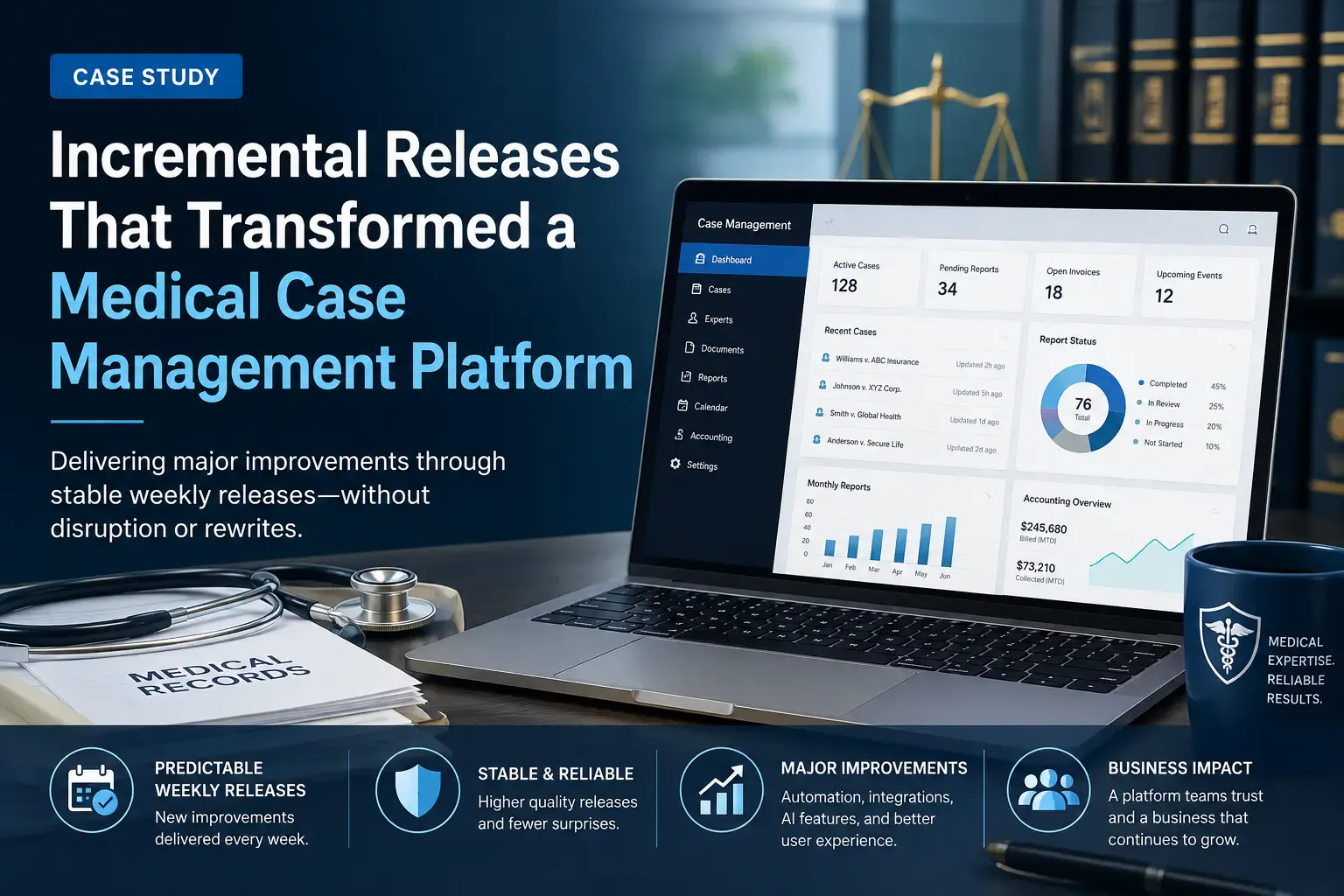
Incremental Releases That Transformed a Medical Case Management Platform
Some software problems are easy to spot. The application crashes. Reports fail. Users complain. Others take longer to notice.
For one of our clients, a company providing medical billing expert witness services for civil litigation, the biggest issue was not that their software could not do its job. It actually did a lot.
Their in-house case management platform handled complicated workflows, large databases, document management, accounting integrations, and the detailed cost evaluation reports that their business depends on every single day.
Some software problems are easy to spot. The application crashes. Reports fail. Users complain. Others take longer to notice.
For one of our clients, a company providing medical billing expert witness services for civil litigation, the biggest issue was not that their software could not do its job. It actually did a lot.
Their in-house case management platform handled complicated workflows, large databases, document management, accounting integrations, and the detailed cost evaluation reports that their business depends on every single day.
The challenge was something quieter. Every new feature felt difficult to release. Their application, built with .NET Blazor and hosted in Microsoft Azure, had gradually evolved as new functionality and workflows were introduced. As the platform became more widely used in day-to-day operations, even relatively small improvements required careful coordination to avoid affecting existing functionality.
Features often spent weeks moving through internal development cycles before anyone felt comfortable deploying them. Even then, releases could still create unexpected problems elsewhere in the system. It slowly became the kind of software that nobody wanted to touch unless they absolutely had to.
The Backlog Kept Growing
There were plenty of good ideas waiting to be built, but delivering them consistently had become harder than writing them down. Instead of recommending a complete rebuild, we focused on something much simpler. We helped create a development process that everyone could trust again.
Every Week Started With Planning
Rather than disappearing for months and returning with a large release, our team met regularly with the client to discuss priorities for the following week. Together, we reviewed their Kanban boards, clarified requirements, estimated effort, and agreed on what could realistically be delivered.
It sounds straightforward. But having that rhythm changed almost everything. Developers knew exactly what they were building. Stakeholders knew what to expect. And the backlog slowly stopped feeling overwhelming.
Once development began, every change followed the same process. Features were built, reviewed, tested thoroughly, and prepared for release. Updates were typically deployed over the weekend, allowing users to start each new week with improvements instead of surprises.
The Outcome
Over time, confidence replaced hesitation.
Alongside the ongoing improvements and weekly releases, we also delivered several larger enhancements that supported the client's long-term goals. One of the most significant was a new automated report generation system.
Since these reports are the core product the company delivers to attorneys and clients, consistency matters just as much as speed. Automating the process reduced repetitive work while helping ensure every report followed the same standards and contained reliable information.
At the same time, we tackled several technical issues that users had simply learned to work around. We resolved issues affecting the QuickBooks integration, improving the reliability of accounting workflows. We also refined the document management system, making files easier to organize, access, and manage as part of everyday work.
Some of the most valuable improvements were actually the smallest ones. Screens became easier to use. Common tasks required fewer clicks. Workflows that previously needed formal training suddenly felt obvious.
Eventually, many new employees could begin using the platform with very little guidance because the software itself had become much more intuitive. We also introduced a scheduling and calendar management system that made it easier to coordinate expert witness availability across active cases.
Artificial intelligence was already part of the platform, but there was an opportunity to make it more useful in everyday workflows. We refined the existing document field extraction experience to make it smoother and more intuitive for users. We also developed a new AI-powered report generation feature that helped medical billing experts prepare opposing expert reports more efficiently, reducing repetitive work while maintaining consistency across their reports.
Looking back, the biggest result was not any single feature. It was the way the software started evolving. Instead of waiting months between risky releases, the client could confidently improve the platform almost every week. Problems were identified earlier, new functionality reached users faster, and development became far more predictable than it had been before.
Today, the system continues to support a growing business that handles more cases than before without the software becoming a bottleneck. Sometimes, improving technology is not about replacing everything. Sometimes it starts by making the next release feel a little less risky than the last one.